
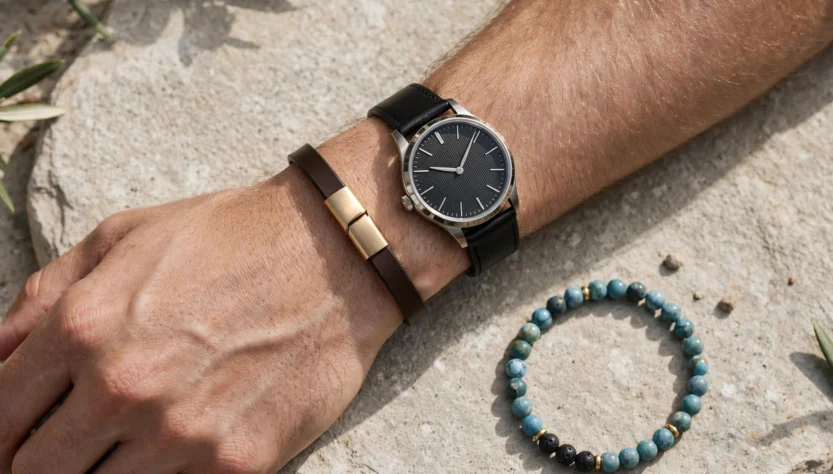
Most men wear a bracelet the wrong way for one simple reason. They copy a photo, not a fit. A bracelet should sit comfortably, move a little, and match the rest of the outfit. It should not slide to the fingers, dig into the wrist, or fight with a watch.
Short answer: Wear a bracelet on the wrist opposite your watch, or on the same wrist only if the fit is slim and the bracelet sits clear of the watch case. Leave about one finger of room between the bracelet and your wrist. Keep it simple at work, and save stacking for casual days.
Which Wrist Should Men Wear a Bracelet On?
There is no strict rule, but there is a practical choice. Most men wear a watch on the left wrist. That leaves the right wrist free for a bracelet. The bracelet then has space, it does not scratch the watch, and it does not catch on a shirt cuff in the same way.
If you do not wear a watch, wear the bracelet on your non dominant wrist. That wrist moves less during writing and typing, so the bracelet stays in place and suffers less wear. If you are left handed, the right wrist is usually the better choice.
Wearing a bracelet on the same wrist as a watch can work. It works best with one slim bracelet, in a different texture from the watch strap. A chunky bracelet next to a large watch case looks crowded, and the two pieces will knock together all day.
How Should a Men’s Bracelet Fit?
Fit matters more than style. A bracelet that is too tight looks uncomfortable, because it is uncomfortable. A bracelet that is too loose slides over the hand and gets in the way.
Measure your wrist with a soft tape, just below the wrist bone, where you will wear the bracelet. Then add room for movement. The table below gives a simple guide.
| Fit | Room to add | Best for |
|---|---|---|
| Snug | About 1 cm | Beaded bracelets and slim chains that should stay in place |
| Comfortable | About 1.5 cm | Everyday leather and link bracelets |
| Relaxed | About 2 cm | Wide cuffs and casual bangles |
As a quick check, you should be able to slide one finger under the bracelet, but not your whole hand. If the bracelet passes over your knuckles without effort, it is too loose for daily wear. If it leaves a mark after a few minutes, it is too tight.
Check the fit again in warm weather. Wrists swell slightly in heat, and leather softens with wear. A bracelet that fits perfectly in winter may feel snug in summer.
Which Types of Men’s Bracelet Suit Which Occasion?
Leather bracelets suit casual and smart casual outfits. A single dark leather band works with jeans, a shirt and boots. It also works under a blazer, as long as it stays slim and plain.
Beaded bracelets suit casual days, holidays and weekends. Stone, wood and lava beads add texture, but they can look busy at work. Wear one beaded bracelet at a time, not three different colours at once.
Metal chains and link bracelets suit both casual and smarter looks, depending on width. A slim steel or silver chain looks neat with a shirt. A thick curb chain is a statement piece, so let it be the only statement in the outfit.
Cuffs suit confident, simple outfits. A plain metal cuff works with a dark shirt and dark trousers. An engraved or patterned cuff needs a plain outfit around it, or the look becomes noisy.
How to Pair a Bracelet With a Watch
Match the tone, not the exact metal. A silver watch pairs well with steel, silver or dark leather. A gold watch pairs well with gold, brown leather or black leather. Mixing silver and gold can work, but only if one metal clearly leads and the other is a small accent.
Keep the bracelet thinner than the watch strap, if they share a wrist. The watch should stay the main piece. If the bracelet is wider than the watch, the eye goes to the bracelet first, and the pairing looks unbalanced.
Leave a small gap between the watch case and the bracelet. A bracelet that sits hard against the case will scratch both pieces over time. If you wear a bracelet on the opposite wrist, this problem disappears, which is one reason the opposite wrist rule is so popular.
For more on how a rigid bracelet behaves next to a flexible one, see our guide to tennis bracelet vs bangle styles, which explains fit and movement in detail.
Stacking Rules That Keep It Simple
Stacking means wearing two or more bracelets together. It can look good, but only with restraint. Start with two pieces, not four. Vary texture, not colour. A leather band with a beaded bracelet works. Two chunky metal chains together usually do not.
Keep one piece plain. If one bracelet has beads, make the other plain leather or plain metal. If both have pattern, the stack looks cluttered from a normal distance.
Stack on one wrist only. A bracelet on each wrist, plus a watch, gives three focal points, and the outfit loses its centre. Choose the bracelet wrist, then leave the other wrist to the watch alone.
Men’s Bracelets at Work and in Formal Settings
At work, choose one slim bracelet in a quiet material. Dark leather, plain steel or a thin chain all work in most offices. Avoid noisy beads, bright colours and large charms in formal meetings.
For formal events, a slim metal bracelet or a plain cuff is enough. Skip beaded stacks and wide leather wraps. The bracelet should be noticed only on a second look, not from across the room.
For casual days, you have more freedom. A beaded bracelet, a leather wrap or a two piece stack all work with jeans and a T-shirt. Even here, keep the colours close to the rest of the outfit. Black, brown, navy and grey are the safest starting points.
Men’s Necklace Lengths in Brief
Necklace length works on the same principle as bracelet fit. Measure first, then choose by collar and pendant drop. A 45 cm chain sits at the base of the neck on most men. A 50 cm chain sits on the collarbone. A 55 to 60 cm chain sits on the chest, and suits a pendant.
Shorter chains suit crew necks and open collars. Longer chains suit V necks and layered looks. If you wear a pendant, add length for the drop, so the pendant does not sit high on the neck. A pendant that pulls the chain tight looks wrong, even if the chain length is correct on paper.
Keep the necklace and bracelet in the same metal family where possible. A silver chain with a brown leather bracelet works, because leather is neutral. A gold chain with a silver bracelet needs a reason, such as a watch that already mixes metals.
Common Mistakes to Avoid
Do not wear a bracelet over a shirt cuff. The bracelet belongs on the wrist, under the cuff, or on a bare wrist. Over the cuff, it slides, catches and looks like an afterthought.
Do not mix too many materials at once. Leather, beads, metal and rope in one stack is four textures competing for attention. Pick two at most.
Do not ignore the clasp. A weak clasp will fail at the worst moment, often when you take off a coat. Check magnetic clasps for strength, and check lobster clasps for a clean close, before you rely on them for daily wear.
Do not buy by wrist size alone. Check the bracelet length, the clasp type and the material. A stretch beaded bracelet fits differently from a fixed link bracelet in the same stated size.
Frequently Asked Questions
Should men wear bracelets on the left or right wrist? Wear it on the wrist opposite your watch, or on your non dominant wrist if you do not wear a watch. Either choice works, as long as the bracelet has room to move.
How tight should a men’s bracelet be? It should allow about one finger of room under the band. It should not slide over your hand, and it should not leave a mark.
Can men wear a bracelet with a watch on the same wrist? Yes, if the bracelet is slim and sits clear of the watch case. Keep the watch as the main piece, and avoid chunky stacks on the same wrist.
How many bracelets should a man wear at once? One for work and formal settings. Two at most for casual stacking, with one plain piece in the pair.
What bracelet material is best for everyday wear? Leather and steel are the easiest everyday choices. Leather softens with wear, steel resists scratches, and both suit most outfits.
Do men’s bracelets suit older men? Yes. A slim leather band or a plain metal bracelet suits every age. The key is fit and simplicity, not age.
Conclusion
A good men’s bracelet is a quiet piece, not a loud one. Measure your wrist, leave room to move, pair it with your watch instead of fighting it, and keep stacks simple. Start with one well fitting bracelet in a neutral material, then add a second piece only when the first one feels natural. That approach works for work, for weekends, and for formal days alike, and it keeps the focus on the outfit as a whole. For a broader everyday approach, our everyday jewellery capsule guide shows how a small set of pieces can cover work and weekend looks.